Astraware Wordsearch
- 4.5
- Rating
- 10.00K
- Installs
- Free
- Price
 Analysis by App-foxy
I usually give word games a few days before deciding whether they deserve a permanent place on my phone. The first impression can be misleading: a clean puzzle may feel relaxing at first, then become repetitive once the novelty disappears. Astraware Wordsearch made a better opening impression than many basic word-search games because its central task is immediately understandable while still giving me a reason to replay a puzzle and improve my time. It is a free word game from Astraware Limited, rated for Everyone, and its simple focus makes it easy to pick up without learning a complicated ruleset.
The idea is familiar: find hidden words in a letter grid, with speed playing an important part. What matters here is how naturally the game fits small gaps in the day. I can open it while waiting for an appointment, play a short session during a break, and put it away without needing to remember a story, manage a character, or rebuild a strategy. That simplicity is also the main question for long-term use. If you want a deep puzzle system, this may feel light. If you want a focused mental warm-up that does not demand much attention, it has a convincing case.
Why the first week feels satisfying
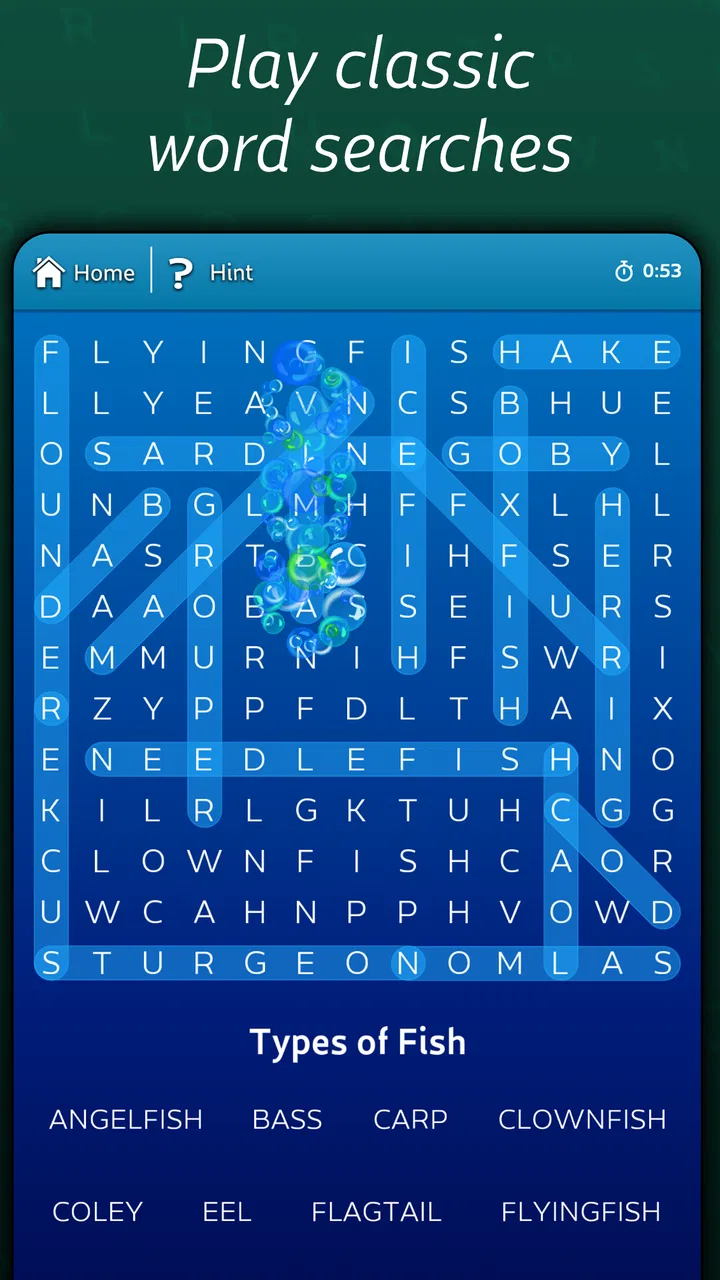
During the first week, the strongest quality is the low barrier to entry. I do not need to study instructions or understand a complicated scoring economy before starting. The visual search itself becomes the challenge: I scan rows, columns, and diagonals, recognize likely letter patterns, and try to avoid wasting time on false leads. The faster-time objective gives an ordinary word search a little urgency without turning it into an aggressive competition.
You May Also Like

 Blood Strike: 2.5 Anniversary
Blood Strike’s Loadouts Turn Every Drop Into a Tactical Gamble
A close look at Blood Strike’s custom loadouts: how fast access to signature weapons reshapes its battle royale rhythm, rewards preparation, and narrows the gap between fights.

 Pandora - Music & Podcasts
Pandora’s Music Is Easy to Start, but Harder to Recover
Pandora’s strength is its low-effort path from a seed to a station. Its weak spot is how much confidence it asks you to place in connection, setup, and quiet recovery.

 8 Ball Pool
 Is Built on Rivalries, Rematches, and Routine
A close look at the rivalries, rematches, shared routines, and unanswered safety questions that turn a quick pool match into a persistent mobile community.

 Samsung Music
’s Quiet Strength Is Playing What You Already Own
Its reach comes less from spectacle than from dependable access to a personal library. That simplicity is both the app’s strongest retention engine and its ceiling.

 AccuWeather: Weather Radar
AccuWeather Review: A Quick, Clear Forecast for Everyday Decisions
For everyday plans, the best forecast is the one you can understand quickly. AccuWeather makes rain timing, radar, and local conditions easy to act on, with a few trade-offs.

 Hill Climb Racing
Why Hill Climb Racing Still Turns Crashes Into One More Run
A tiny car, a bumpy hill and one more upgrade: Hill Climb Racing keeps resurfacing because its simple chaos makes every near-miss feel personal.
More From Our News Desk
View All News


That balance works particularly well when I am mentally tired. A crossword can require a specific vocabulary or a willingness to sit with clues I cannot solve. A word-search puzzle asks for a different kind of attention. I already know what I am looking for, so the effort goes into visual tracking and concentration rather than interpreting hints. After a demanding work session, that makes it a useful reset. It occupies my mind enough to interrupt distractions but does not ask me to make a long-term commitment.
One practical tip is to change the way you scan instead of staring randomly at the whole grid. I get better results by checking the first letter of a target word, then looking outward along the directions where it could appear. When several words begin with the same letter, I compare their next letters before moving on. This approach is more reliable than sweeping across every line and helps the time challenge feel skill-based rather than purely dependent on luck.
The game is also approachable for mixed-age households. Because the content rating is Everyone, it can suit a family member who wants a gentle vocabulary activity rather than a more intense game. That does not mean every player will find it equally engaging. Younger players may enjoy the hunt, while experienced puzzle fans may want more variety or a stronger sense of progression. I would describe it as accessible first and demanding second.
Its free entry point makes trying it straightforward. The optional in-app purchases range from $0.99 to $7.99 per item, so I would check the purchase screen carefully before spending anything and decide whether the free experience already meets my needs. For a casual player, the sensible approach is to use the game for several sessions before considering an add-on. The basic appeal is the search itself, not the promise of a large collection of extras.
The first-week appeal also comes from the absence of narrative pressure. I am not asked to keep track of characters, return at a particular time, or protect a streak in order to understand the game. That makes it a good companion for travel or waiting rooms, especially when I want something more active than scrolling but less involved than a full-length game. It is easy to stop after one puzzle, which is a small but important advantage for responsible casual play.
How it compares with familiar word-game choices
Compared with a crossword, Astraware Wordsearch is more immediate and less dependent on clue knowledge. A crossword rewards deduction and language recall; this game rewards visual patience, pattern recognition, and speed. Compared with a spelling or anagram game, it gives me the answer list and asks me to locate rather than construct words. That makes it less educational in a direct spelling sense, but often more relaxing.
It also occupies a different space from daily word games built around one carefully limited attempt. Those games create anticipation and conversation, while this style of word search is better for repeated short sessions. I can play when I have a few spare minutes without worrying that I have used up the day’s main challenge. The trade-off is that the experience may feel less memorable. There is no single daily result that naturally becomes a talking point.
For someone choosing between this and a more feature-heavy word-game collection, I would ask what kind of friction they tolerate. If you enjoy unlocking systems, tracking several modes, or building a long progression path, another option may hold your attention longer. If you want to open a puzzle and start searching immediately, the focused design is an advantage rather than a missing feature.
What remains useful after the novelty fades
The month-to-month value depends on whether you enjoy repeating a familiar mental exercise. In my experience, the game stays useful when I treat it as a small concentration routine instead of expecting constant discovery. The appeal is not that every session transforms the format. It is that the same basic action can serve different moods: a quick warm-up in the morning, a quiet break from work, or a screen activity before bed when I do not want something loud or complicated.
The time objective gives replaying a purpose. After finishing a puzzle, I can return with a more deliberate scanning method and try to reduce hesitation. That creates a modest personal challenge even when the rules remain unchanged. I find this more sustainable than a game that relies only on unlocking new material, because improvement can come from my own attention. Still, the motivation is personal. Players who need frequent rewards, new mechanics, or a visible long-term campaign may run out of reasons to return.
A useful routine is to separate accuracy sessions from speed sessions. On the first pass, I focus on finding every word without rushing. Later, I replay with the goal of recognizing common patterns more quickly. This prevents the fastest-time objective from turning every session into frantic tapping. It also helps reveal whether the game is improving my concentration or merely encouraging me to scan carelessly.
The game’s age is worth considering in a practical way. It was released on November 5, 2013, and the current version is 2.93.002. Its minimum operating-system requirement is iOS 9, which makes it broadly approachable on older compatible Apple devices. That can be valuable if you keep an older phone or tablet for casual use. At the same time, anyone looking for a modern visual showcase should adjust expectations. This is a focused puzzle product, not a reason by itself to buy a new device.
Its audience size suggests that it has found a stable niche rather than being an obscure experiment. The game has over 10,000 installs, with an average rating of 4.5 from around 410 ratings and about 60 written reviews. I would treat that as encouraging evidence of player satisfaction, while remembering that ratings cannot tell me whether the game matches my preferred level of variety. A well-liked simple puzzle can still be the wrong choice for someone who wants a constantly changing experience.
Month-to-month value is strongest for people who already enjoy word searches on paper. The digital format removes the need for a pencil, lets me play almost anywhere, and makes timed replay convenient. It is also useful for people who want a low-pressure activity that supports a short attention break. I would be less likely to recommend it as a primary game for someone who expects a large social layer, deep customization, or a substantial progression system.
Keeping the habit without making it a chore
Maintenance is one of the product’s quiet strengths. There is no complicated account routine in the experience I reviewed, and the game does not require me to learn a rotating set of systems before I can enjoy a puzzle. That lowers the mental cost of returning after a few days away. I can simply pick it up again and rely on the same basic skill set.
There is a difference, however, between low maintenance and endless freshness. A simple word-search game does not need much care from the player, but it also gives fewer external reasons to come back. I recommend setting a modest personal rule, such as playing one puzzle during a regular break rather than opening it whenever boredom appears. That turns it into a useful habit instead of another app I check automatically.
For a parent or someone sharing a device, the Everyone rating makes the title easier to consider for a broad household. I would still keep purchase awareness in mind, particularly if another person can use the device. The presence of in-app purchases means a free download should not be treated as the same thing as an entirely purchase-free experience. Reviewing the purchase controls on the device is a sensible step before handing it to a child.
Storage and compatibility are also part of maintenance, even when they are not exciting topics. Because the minimum requirement is iOS 9, the game may be a practical candidate for an older compatible device that no longer handles demanding modern games comfortably. That makes it useful as a lightweight backup activity. On a newer phone, the same quality may feel less impressive because the hardware is capable of much more elaborate games.
The best workflow I found was to use it intentionally in places where a short, self-contained activity is helpful. I might play while waiting for a train, then stop without losing the rest of my evening. I would not use it as background entertainment while watching television, because the visual search needs enough attention to be satisfying. It is a better replacement for idle scrolling than a second-screen companion.
Where fatigue begins
The main source of fatigue is repetition. Finding hidden words is pleasant when I am in the mood for visual searching, but the format does not change its identity from one session to the next. If I play for too long, the activity can become mechanical. My eyes move across the grid, I spot familiar patterns, and the satisfaction of completion starts to shrink. This is not a flaw unique to this title, but it matters when deciding whether it deserves permanent space.
The emphasis on speed can create another kind of wear. Some players will enjoy chasing a faster result, while others may feel that rushing makes the puzzle less relaxing. I prefer alternating between careful and timed play. If the game’s central challenge is not enjoyable without the clock in mind, its long-term value will probably be limited for you.
There is also a vocabulary trade-off. Word searches can expose me to words I recognize only vaguely, but they do not necessarily teach definitions or spelling in the way a dictionary-based game might. If your goal is deliberate language study, I would choose a tool built around definitions, pronunciation, or sentence use. This game can support attention and word recognition, but I would not mistake it for a complete learning program.
Players who need strong accessibility options should make their decision carefully and test the interface on their own device. Visual search naturally depends on reading small letters and distinguishing positions in a grid. Anyone with eye strain may prefer shorter sessions, a larger screen, or a different kind of word game. I would not recommend committing to long play sessions simply because the puzzles are easy to start.
Another limitation is emotional rather than technical: there is little narrative attachment. If you enjoy games because you want characters, surprises, or a world to explore, this title will not replace those experiences. Its restraint is exactly what makes it convenient, but that same restraint limits its ability to become a central hobby. I see it as a dependable side activity, not a game I would build my entire leisure time around.
Who should keep it installed
I would keep Astraware Wordsearch installed if I wanted a free, uncomplicated word game for short sessions and enjoyed measuring my own improvement. It is especially suitable for fans of traditional word searches, people who prefer visual puzzles to clue-based puzzles, and anyone who wants a calm activity that can be stopped at any moment. The low learning curve is a real benefit when I have only a few minutes.
I would skip it if I need constant novelty, online competition, a rich progression system, or a more educational vocabulary experience. I would also look elsewhere if timed searching makes me anxious rather than focused. A crossword app would be a better fit for clue solving, an anagram game for constructing words, and a larger puzzle suite for someone who wants several formats in one place.
For everyday use, my advice is to try it in three different situations: a quick break, a relaxed evening session, and a deliberate attempt to improve a previous time. If it works in at least two of those settings, it is likely to earn recurring value for you. If it feels repetitive after only a few puzzles, no amount of routine will change the underlying format enough to make it a lasting match.
Astraware Limited has kept the product focused rather than turning it into an overloaded word-game hub. I appreciate that clarity. The free price removes much of the risk of testing it, while the optional purchases mean I would still pay attention before confirming anything. The combination of an Everyone rating, an older minimum operating-system requirement, and a modest install footprint in the wider app landscape makes it a practical choice for casual play on a compatible Apple device.
My long-term verdict is positive but measured. This is not a game I would recommend because it promises endless surprises. I recommend it because it delivers a specific kind of small, repeatable satisfaction: scan, recognize, find, and try to do it more cleanly next time. Its lasting value comes from fitting neatly into real breaks, not from overwhelming you with content. If that sounds like the kind of habit you want, it earns a place on your device. If you need a deeper system to keep pulling you back, enjoy it as a brief trial and then choose a more varied word-game alternative.
FAQs for Astraware Wordsearch
01What is Astraware Wordsearch?
Astraware Wordsearch is a word-finding puzzle game for Android and iOS in which you search grids of letters to discover hidden words. It is designed for casual play, with themed puzzles and a straightforward interface that makes it easy to start a game quickly. The app is suitable for short sessions, although dedicated players can spend much longer completing challenges and improving their solving speed.
02How does the gameplay in Astraware Wordsearch work?
Each puzzle presents a grid filled with letters and a list of words to find. You locate a word horizontally, vertically, diagonally, or in reverse, then drag across the letters to mark it as completed. The game generally becomes more challenging as the grids grow or the word lists become harder to scan. Its simple controls make the experience accessible on both phones and tablets.
03Does Astraware Wordsearch work offline?
Astraware Wordsearch is generally suitable for playing without a constant internet connection, which is useful when traveling, commuting, or trying to save mobile data. However, some functions may still depend on the platform, such as downloading the app, checking for updates, restoring purchases, or displaying advertisements. It is a good idea to open the game once online after installation so any required content can load correctly.
04Is Astraware Wordsearch free to download?
Availability and pricing can vary between the Google Play Store and Apple App Store, and the publisher may offer different editions or in-app purchase options over time. Before downloading, check the store listing for the current price, advertisements, supported devices, and any optional purchases. If you want an uninterrupted experience, review whether the version includes ad removal or additional puzzle content.
05Who should download Astraware Wordsearch?
Astraware Wordsearch is a good choice for players who enjoy relaxed vocabulary puzzles, visual searching, and games that can be completed at their own pace. It does not require fast reflexes or complicated strategies, making it approachable for many ages. People looking for a highly competitive multiplayer game or a story-driven experience may find it too simple, but word-puzzle fans should appreciate its focused format.
Pros
- Large variety of themed puzzles keeps gameplay fresh.
- Adjustable difficulty suits both casual and experienced players.
- Offline play lets you enjoy puzzles without an internet connection.
- Clear interface makes words easy to find on smaller screens.
- Helpful hints are available when a puzzle becomes challenging.
Cons
- Some features or puzzle packs may require additional purchases.
- The search grid can feel cramped on smaller phone displays.
- Repeated themes may reduce variety during longer play sessions.
- No competitive multiplayer mode for challenging friends directly.
- Ads may interrupt play in the free version.

Astraware Wordsearch
Gallery